
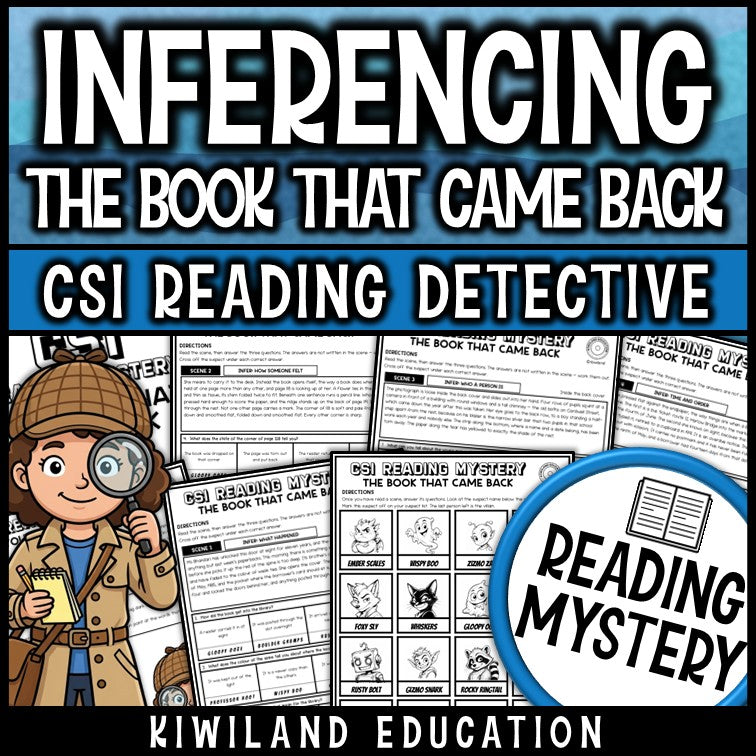
Making Inferences
Reading Mystery Worksheets · Grades 3–5 · The Book That Came Back
Instant PDF download after checkout. Prefer TPT? It's there too.
Inside the case file
Nothing in this case is stated outright — every answer has to be worked out from the evidence on the page, which is exactly what makes it inference practice rather than recall. Students read five short scenes, answer three questions on each, and copy the words that prove it before crossing a suspect off the line-up. Printable, self-checking and no prep, it drops into literacy centers, small groups, early finishers, sub days and homework for Grades 3–5.
Quick Details
Skill: Making inferences, drawing conclusions and citing text evidence · Grades: 3–5 · Format: 5 scenes × 3 questions, written response and full answer keys (printable PDF, color and black-and-white) · Theme: The Book That Came Back
The Case
Ms Bhandari has unlocked the library door at eight for eleven years, and the returns trolley has never held anything but last week's paperbacks. This morning there is something else on it, and she knows it is wrong before she picks it up — the red of the spine is too deep, while its brothers on the shelf have faded to the colour of weak tea. The last date stamped inside is the ninth of May, 1985. The pocket where the borrower's card should sit is empty. She emptied this trolley at four and locked the doors behind her. Inside the cover is a pressed flower, a pencil line scored hard under one sentence, and a single corner folded down and smoothed flat, over and over.
The 5 Scenes
Scene One — Infer What Happened — Monday, 8:02 a.m. The book on the trolley should not be there, and students work out how it arrived.
Scene Two — Infer How Someone Felt — Page 118. A pressed flower, a scored pencil line and one soft corner say what the reader felt without ever saying it.
Scene Three — Infer Who a Person Is — Inside the back cover. Students build a picture of the borrower from what they left behind.
Scene Four — Infer Time and Order — Tucked at page 3. The clues have to be put back into the order they happened.
Scene Five — Infer Cause, Then Predict — Page 118 again. Students explain why it happened and say what comes next.
How the Reading Mystery Works
Students take on the role of Reading Detectives. Each scene is followed by three questions whose answers are not written in the text — they have to be reasoned out — plus a PROVE IT prompt asking students to copy the exact words that gave them their answer. Every correct answer names a suspect to cross off, and the last person standing is the culprit.
What's Included
- A "You are a detective" case-file page that sets the scene and the mission
- Five short scenes, each with three inference questions
- A PROVE IT text-evidence prompt on every scene
- A suspect line-up page for eliminating names one clue at a time
- Written-response pages with sample answers
- A themed word search and extension activities for early finishers
- Self-checking answer keys for every page
- Full color and ink-saving black-and-white versions
- Teacher instructions and print-and-go PDF format
Skills Covered
- Making inferences about events, feelings, character and cause
- Drawing conclusions and predicting what happens next
- Quoting and citing the exact text evidence behind an answer
- Sequencing and reasoning about time from indirect clues
- Vocabulary in context
- Logical reasoning and deductive elimination as suspects are ruled out
Best Used For
- Inference and text-evidence units
- Literacy centers and guided reading groups
- Morning work, homework and early finishers
- Substitute and relief days
- Small-group reading and intervention
- Comprehension review and test prep for Grades 3–5
More From This Line
Browse every Reading Mystery, or pair it with The Midnight Gardener and The Baker's Dozen.
You might also like
 Figurative Language WorksheetsSee the case file →
 Text Structure WorksheetsSee the case file →
 Main Idea and Supporting Details Reading Mystery Task CardsSee the case file →
 Finding The Theme Reading Mystery Task Cards 5th Grade Activity WorksheetsSee the case file →
 All About WitchesSee the case file →
 HalloweenSee the case file →