
Figurative Language Worksheets
Literacy Mystery Activities · Grades 3–6 · Simile and Metaphor
Instant PDF download after checkout. Prefer TPT? It's there too.
Inside the case file
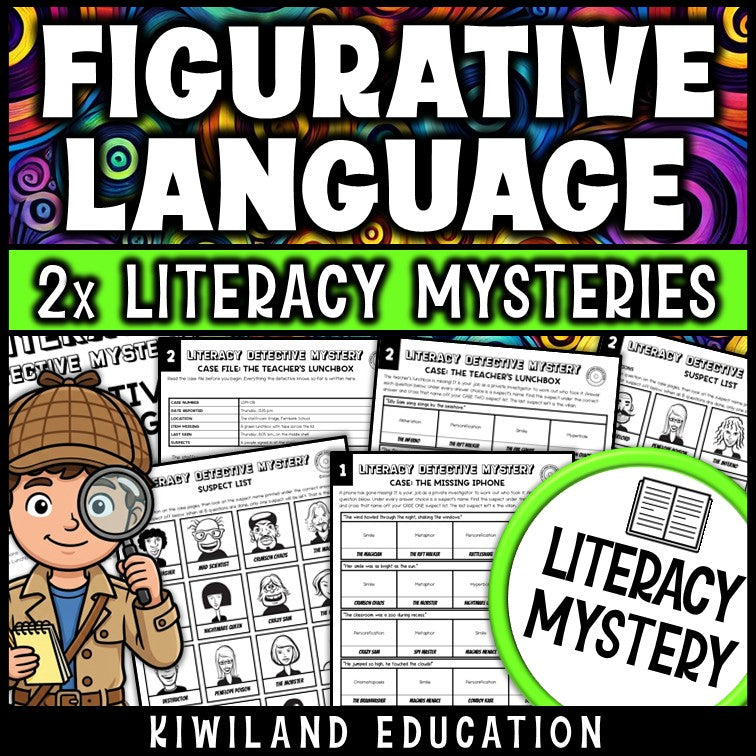
Two detective cases put figurative language to work — students read the case file, name the device the writer has used in each short sentence, and use every correct answer to cross a suspect off the police lineup until one culprit is left standing. Written for 3rd, 4th, 5th and 6th grade readers practising simile, metaphor, personification, hyperbole, alliteration and onomatopoeia, and completely no prep.
Quick Details
Skill: Figurative language · Grades: 3–6 · Format: 2 cases + full answer keys (printable PDF) · Theme: Detective mystery
The 2 Cases
THE MISSING IPHONE — A phone in a cracked blue case goes into the tray on Mr Okafor's desk on Monday morning and is gone by half past two, with the spare charger, the raffle tin and the class camera all still sitting beside it. Sixteen people came through Room 12 that day, and one of them reached into that tray exactly once.
THE TEACHER'S LUNCHBOX — Ms Delgado's green lunchbox, taped at the lid, goes onto the middle shelf of the staffroom fridge at five past eight and leaves a clean empty space by half past twelve. The milk is untouched and the birthday cake still has its ribbon tied. Sixteen people signed in at the staffroom door that morning, and only the clues will say which one left with something that was not theirs.
Why Teachers Love It
- Zero prep — print and go, no cutting, no laminating, no locks to buy
- Self-checking: two suspects left standing means a question to go back to, so students catch their own mistakes
- The detective hook pulls in reluctant and struggling readers who switch off at a worksheet
- Two separate cases make it easy to split across a week, differentiate, or hold one back for a sub day
- Teacher instructions on page one, so anybody can pick it up and run it
Skills Covered
- Identifying similes — the like or as that gives them away: her smile was as bright as the sun
- Identifying metaphors, where one thing simply IS another: the classroom was a zoo during recess
- Identifying personification, when something does what only a person can do: the leaves whispered secrets to the wind
- Identifying hyperbole, exaggeration pushed far past what is possible: he jumped so high, he touched the clouds
- Identifying alliteration and onomatopoeia — Peter Piper picked a peck of pickled peppers; bang, boom, crackle, pop
- Telling apart the devices students confuse most — metaphor against personification, simile against alliteration
- Writing original similes, metaphors and personification about the case, and explaining which is stronger
- Logical reasoning and deductive elimination as students rule suspects out clue by clue
What's Included
- A one page illustrated case file for each mystery, with an evidence panel and the story of the crime
- A student Figurative Language Guide page — what each of the six devices does and how to spot it
- Multiple choice clue pages and a sixteen suspect line-up for each case
- A Detective's Notebook page per case for recording every suspect crossed off
- Written response extension pages with sample answers
- Complete answer keys, with the correct answers in red
- Teacher instructions and an ink-friendly black and white cover — all in one printable PDF
Best Used For
Reading and literacy centers · morning work · homework · early finishers · substitute and relief days · indoor recess · small group and reading intervention · poetry and creative writing warm-ups · spiral review · test prep · grades 3–6.
You might also like
 Text Structure WorksheetsSee the case file →
 Main Idea and Supporting Details Reading Mystery Task CardsSee the case file →
 Finding The Theme Reading Mystery Task Cards 5th Grade Activity WorksheetsSee the case file →
 All About WitchesSee the case file →
 HalloweenSee the case file →
 End of Year ELA Scoot Mystery Activity – Reading Comprehension Game for Grades 3–5See the case file →