
High school worksheets & activities
Multi-step and literal equations, factoring quadratics, slope and systems, right triangle trigonometry and data displays, with a sharp case to crack on every page. Plus science cases below.
Start here
Three ways in, depending on what you need this week.
The games room
Whole-class games you put on the board and play together. No logins, nothing to set up.
Play a game →
Multi-Step Equations, Variables on Both Sides
HSA-REI.B.3 · linear equations
See the case file →
Right Triangle Trigonometry
HSG-SRT.C.8 · SOH CAH TOA
See the case file →Every high school math skill
Grouped the way the Common Core standards are, so you can find the pack for the unit you're teaching right now.
Algebra: solving equations
HSA-REI.A.1Explain each solving stepHSA-REI.B.3Solve linear equationsHSA-CED.A.4Rearrange formulas
Multi-Step Equations, Variables on Both SidesHSA-REI.B.3 · linear equationsSee the case file → Variables on Both Sides, No ParenthesesHSA-REI.B.3 · zombie casesSee the case file →
 Multi-Step Equations with ParenthesesHSA-REI.B.3 · distributive propertySee the case file →
 Multi-Step Equations Escape RoomHSA-REI.B.3 · digitalSee the case file →
 Absolute Value EquationsHSA-REI.B.3 · Algebra 1See the case file →
 Literal Equations Escape RoomHSA-CED.A.4 · rearrange formulas · digitalSee it on TPT ↗
Algebra: polynomials & quadratics
HSA-SSE.A.2Rewrite expressionsHSA-SSE.B.3aFactor to find zerosHSA-APR.A.1Add & subtract polynomialsHSA-REI.B.4bSolve quadratics by factoring


Linear functions & systems
HSF-IF.B.6Rate of change (slope)HSA-CED.A.3Model with systemsHSA-REI.C.6Solve systems of linear equations


Geometry
HSG-CO.C.9Lines & angle theoremsHSG-SRT.C.6Trig ratiosHSG-SRT.C.8Solve right trianglesHSG-GMD.A.3Volume of cylinders, cones & spheres
Right Triangle TrigonometryHSG-SRT.C.8 · SOH CAH TOASee the case file → Pythagorean TheoremHSG-SRT.C.8 · missing sidesSee the case file →
 Volume of Cylinders, Cones & SpheresHSG-GMD.A.3 · volume formulasSee the case file →
 Parallel Lines & TransversalsHSG-CO.C.9 · angle pairsSee the case file →
 Parallel Lines Escape RoomHSG-CO.C.9 · digitalSee the case file →
Number, quantity & statistics
HSN-Q.A.1Units & conversionsHSN-VM.C.8Add & subtract matricesHSS-ID.A.1Histograms & box plotsHSS-ID.A.2Compare center & spread


Reading, science & more
The same detective format: every right answer clears a suspect. Pick a subject below or from the bar at the top.
Science
Scientific methodPhysical and chemical changesLab safetyChemical bondsGenetics
 Mitosis & Meiosis Reading MysteryReading mystery · Grades 7–10See the case file →
 Ionic & Covalent Bonds Escape RoomDigital escape room · Grades 7–9See the case file →
 DNA Structure & Function Reading MysteryReading mystery · Grades 8–10See the case file →
 Lab Safety Escape RoomDigital escape room · Grades 6–9See the case file →
 Physical & Chemical ChangesReading mystery · Grades 6–9See the case file →
 Fair Test & Experiment DesignDigital escape room · Grades 6–9See the case file →
 Scientific Method Escape RoomDigital escape room · Grades 6–9See the case file →
Escape rooms & games
Scientific methodIntegersMatricesMulti-step equationsLab safety
 Parallel Lines & TransversalsDigital escape room · Grades 7–9See the case file →Ionic & Covalent Bonds Escape RoomDigital escape room · Grades 7–9See the case file →
 Distributive Property & Like TermsDigital escape room · Grades 7–9See the case file →
 Valentine's Day Add & Subtract IntegersDigital escape room · Grades 6–9See the case file →Lab Safety Escape RoomDigital escape room · Grades 6–9See the case file →
 Add & Subtract Matrices Escape RoomDigital escape room · Grades 9–10See the case file →
 Winter Multi-Step Equations Escape RoomDigital escape room · Grades 7–10See the case file →
 Add & Subtract Polynomials Escape RoomDigital escape room · Grades 6–12See the case file →Fair Test & Experiment DesignDigital escape room · Grades 6–9See the case file →
 Two-Step Equations Escape RoomDigital escape room · Grades 7–9See the case file →
The year planner
One math suggestion a month that matches where most classes are in the curriculum.
Reading for high school teachers
Classroom ideas, sub-day plans and seasonal activities.

Summer Activities That Stop the Slide: For Summer School, Home and the Last Week
For the teacher finishing in June, the summer school teacher and the parent asking what to do in July: small, regular, self-checking work on...
Read the post →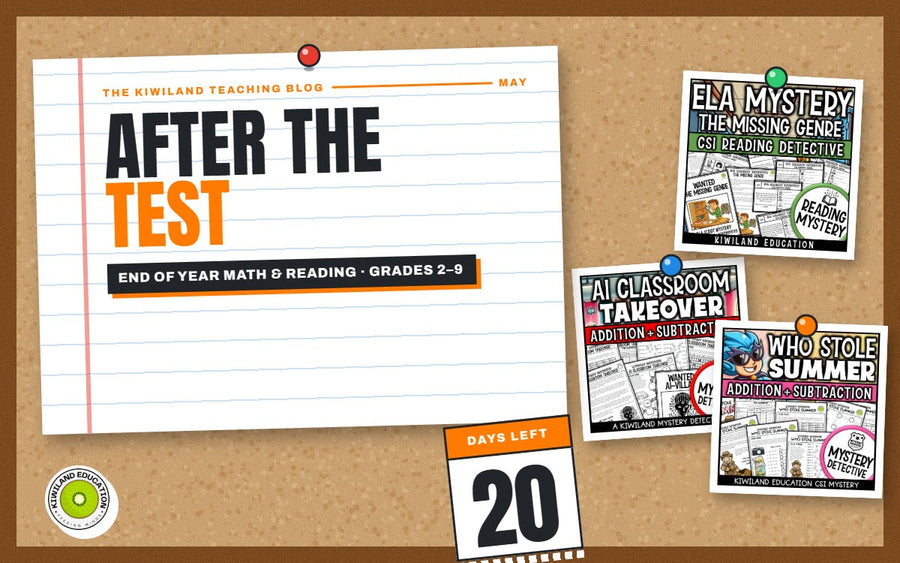
End of Year Activities After Testing: A Plan for the Last Four Weeks
Fifteen to twenty teaching days after the test, planned as a last pass through the year's skills the class will actually finish. Grades 2–9.
Read the post →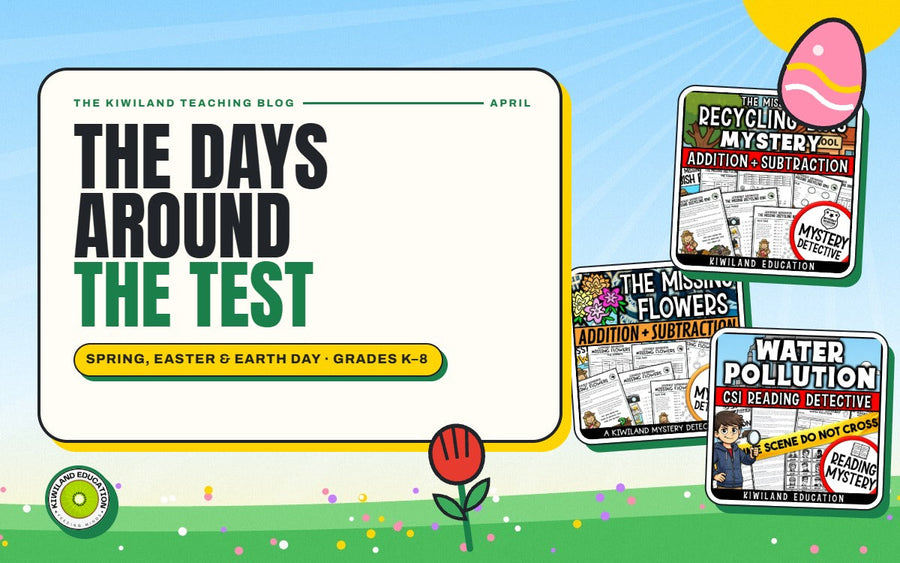
Spring Activities for Testing Season: Easter, Earth Day and the Weeks Between
Built for the days around state testing: short, quiet, self-checking and still on standard. Spring, Easter and Earth Day, K–8.
Read the post →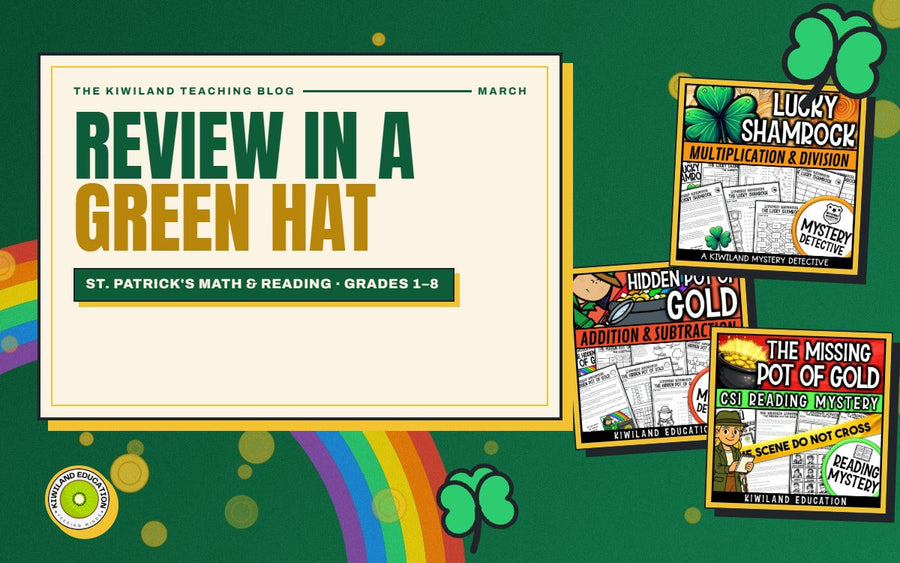
St. Patrick's Day Activities, and the March Review Before Testing
March is the last clear run before state testing. A St. Patrick's week plan, plus the review days around it, for Grades 1–8.
Read the post →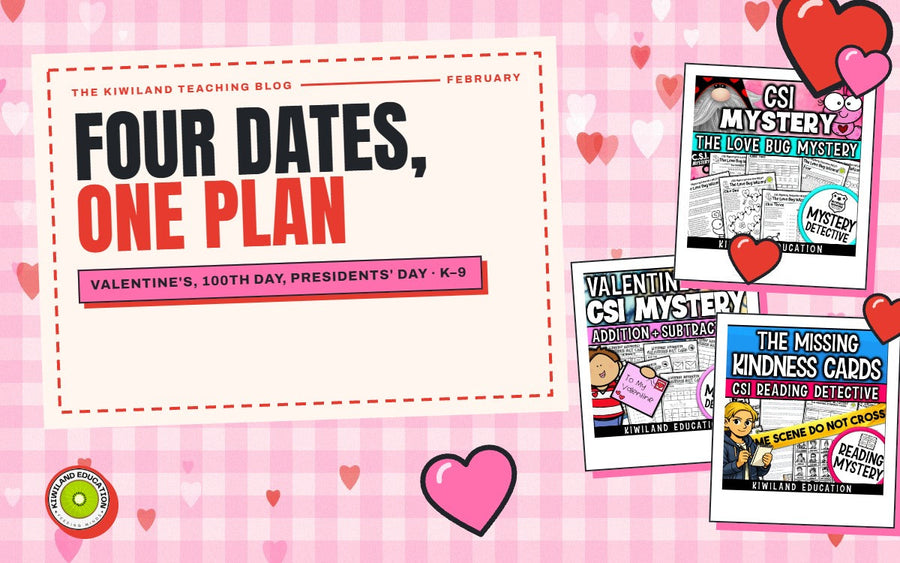
February Activities That Still Teach: Groundhog Day, the 100th Day, Valentine's Day and Presidents' Day
Four holidays in the shortest month. A date-by-date plan with self-checking math cases, reading mysteries and digital escape rooms for K–9.
Read the post →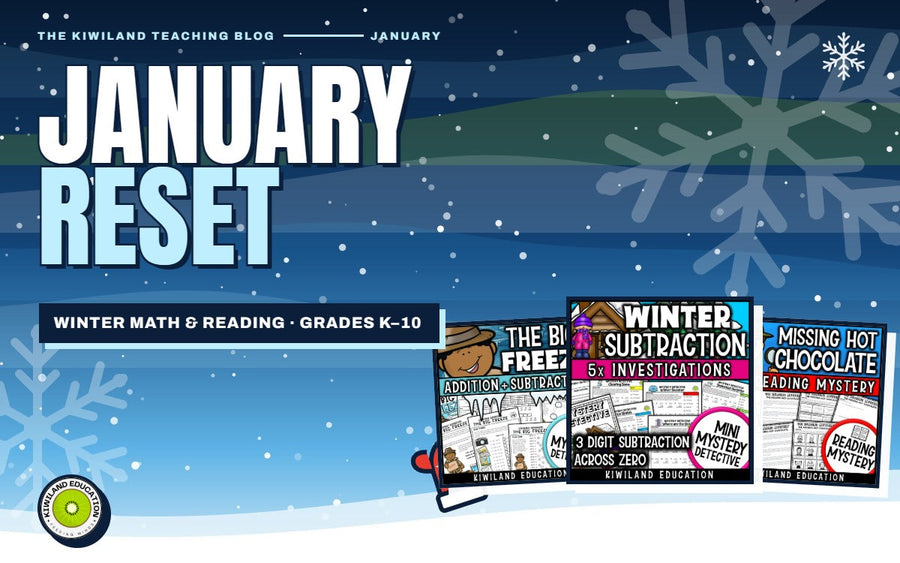
Winter Activities for the First Week Back: A January Reset Plan
The first week of January is a review week, not a fresh start. A first-week-back plan for winter math and reading that puts December...
Read the post →High school FAQ
What math do high school students take?
Most US high schools teach math as Algebra 1, Geometry and Algebra 2, often followed by precalculus, statistics or calculus. Some states use an integrated pathway (Math 1, 2 and 3) that mixes the same content each year. Many students take Algebra 1 in 9th grade, though some start it in 8th grade.
How are the high school Common Core math standards organized?
Instead of grade levels, the high school standards are grouped into conceptual categories: Number and Quantity, Algebra, Functions, Modeling, Geometry, and Statistics and Probability. A code such as HSA-REI.B.3 means High School, Algebra, Reasoning with Equations and Inequalities, cluster B, standard 3, which is solving linear equations in one variable.
What is taught in Algebra 1?
Algebra 1 covers solving linear equations and inequalities, rearranging formulas, graphing linear functions and finding slope, solving systems of linear equations, working with exponents and polynomials, factoring, and solving quadratic equations. Most courses also include some statistics, such as reading histograms and box plots and comparing data sets.
How do you solve a quadratic equation by factoring?
Write the equation in standard form so one side equals zero, factor the quadratic expression, then set each factor equal to zero and solve. For example, x² − 5x + 6 = 0 factors to (x − 2)(x − 3) = 0, so x = 2 or x = 3. This uses the zero product property and is part of standard HSA-REI.B.4b.
Is the Pythagorean theorem taught in middle school or high school?
Students first learn and apply the Pythagorean theorem in 8th grade (8.G.B.7). High school geometry builds on it with right triangle trigonometry, using sine, cosine and tangent together with the Pythagorean theorem to solve right triangles in real-world problems (HSG-SRT.C.8).
What subjects do you have for high school?
Math is the biggest set, with cases for every core standard listed above. There are also science activities in the same detective format: students solve each question, match the answer to a suspect and cross suspects off until one is left.