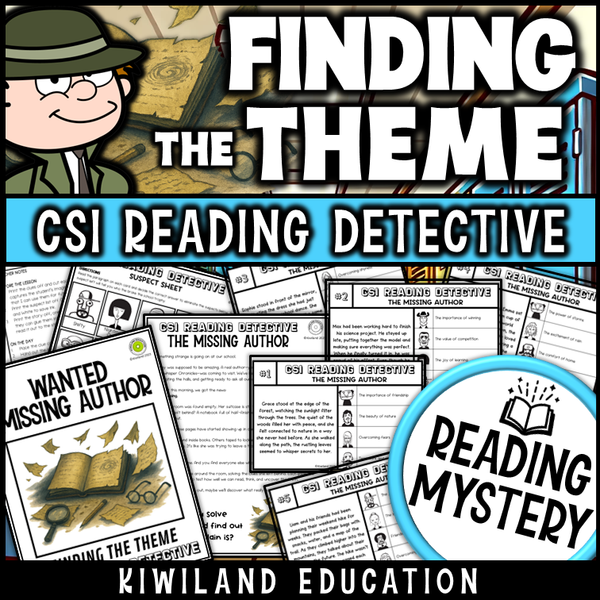
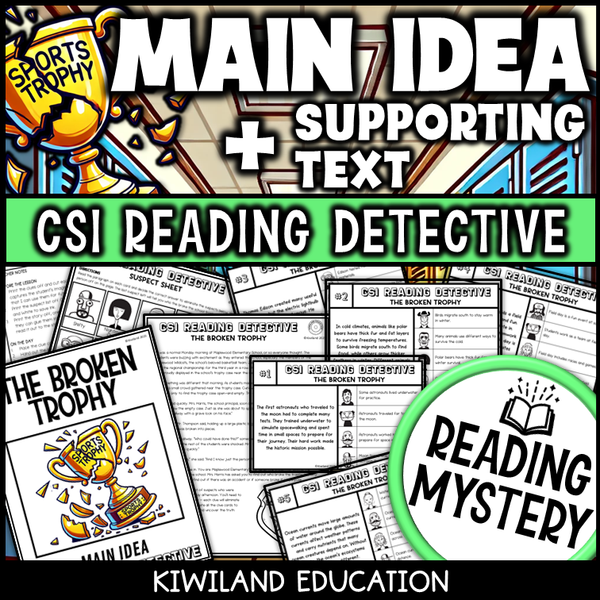
A Math Detective case is a story-based activity where students solve math problems to uncover clues, eliminate suspects, and solve a fictional case. It combines rigorous math review with puzzle-style problem solving, helping students stay engaged while reinforcing key math skills. Popular examples include the Fractions CSI Mystery and the Decimals CSI Mystery.
Math detective cases can be used in the classroom or at home, and they're ideal for review, enrichment, or making math more enjoyable without sacrificing standards or learning goals. New to the reading version? See What Is a Reading Mystery? for the literacy companion to this guide.
How Do Math Detective Activities Work?
Each math detective activity begins with a short story that sets up the case. From there, students must solve a series of math tasks (such as equations, word problems, or puzzles). Each correct set of answers reveals a clue.
Students use these clues to eliminate suspects on a list until they find the solution to the mystery. By the end, they have practiced a wide range of math skills while completing a full logical deduction.
Try one here: The Case of the Divided Monster: Division CSI Mystery, a fun way to teach division through logic and storytelling.
What Skills Do Students Practice in a Math Detective Activity?
Math detective activities are designed to align with grade-level standards and often include:
- Basic facts (addition, subtraction, multiplication, division)
- Place value and number patterns, as in the Playground Bandit place value mystery
- Fractions and decimals
- Area, perimeter, and geometry
- Word problems and multi-step operations
- Data analysis and graph interpretation
- Algebraic reasoning (upper grades)
Looking for a seasonal twist? Check out the Spring Order of Operations Mystery Detective for a fun spring-themed multiplication practice.
What Are the Benefits of Math Detective Activities?
1. High Engagement Without Gimmicks
Students are instantly hooked by the mystery format. Solving a real case gives purpose to every math problem.
2. Critical Thinking and Logic
It is not just computation. Students must apply logic, analyze clues, and make deductions.
3. Curriculum-Aligned Practice
Every activity reinforces essential math standards in a meaningful way.
4. Flexible for Any Classroom
Perfect for centers, group work, whole class, early finishers, or test prep.
5. Low-Prep for Teachers
Just print and go (or use a digital version). Answer keys and instructions are included.
6. Ideal for End-of-Year or Post-Testing Fun
After state testing, students need something different. Math detective activities review key concepts while bringing fun back into the classroom.
Try Multiplying Fractions Mystery with Area Models to keep upper elementary students thinking deeply during those final weeks.
No prep, ready to print
Try a Mystery Detective case this week
Pick a case, print it, and let students solve the math to crack the case. Answer keys and setup instructions are included, so there is nothing to prep.
Browse Mystery Detective →Can Math Detective Activities Be Used After State Testing?
Yes. They are one of the best review tools you can use after testing. Here is why:
- Students are mentally drained, and mysteries feel like a game.
- You can revisit major concepts through a fresh lens.
- They keep kids learning right up to the last week of school.
- Great for calming the post-testing chaos while still teaching.
Engage your students with the 3-Digit Addition Regrouping Mystery Detective. In this activity, students solve addition problems with regrouping to uncover clues and solve a mystery, blending computation with deduction and reading comprehension in a fun, story-driven format.
Can Homeschoolers Use Math Detective Activities?
Absolutely. Math detective activities are perfect for homeschool families because:
- They can be used independently or collaboratively.
- Each mystery includes all the instructions and materials you need.
- They are ideal for mixed-grade households or co-ops.
- They make excellent portfolio pieces showing applied learning.
You can use a mystery once a week, as a unit review, or as part of a family challenge.
What Is Included in a Math Detective Activity?
Most printable or digital math detective activities include:
- A short story setting up the case
- 4-5 math challenge pages
- A suspect list or clue tracker
- Answer keys for self-checking or teacher use
- Bonus activities (e.g., word searches or writing extensions)
Check out the Full Mystery Detective Collection to find bundles by topic, grade, or season.
How Can I Use Math Detective Activities in the Classroom?
Here are teacher-tested ways to implement them:
- Math centers or stations
- Partner or small group work
- Independent student challenges
- End-of-week review
- Sub plans or low-prep days
- End-of-year fun with academic value
What Grade Levels Are Math Detective Activities Best For?
Kiwiland Education offers Mystery Detective packs for:
- Grades 2-3: Focus on fact fluency, basic operations, place value
- Grades 4-5: Include long division, fractions, decimals, and word problems
- Grades 6-8: Dive into ratios, algebraic reasoning, and more advanced applications
Mysteries can also be scaffolded for intervention or extended for enrichment, making them perfect for mixed-ability classrooms.
Are Math Detective Activities Aligned to Common Core or State Standards?
Yes. Each mystery targets one or more grade-level math standards and is designed to provide spiral review and repeated exposure to core concepts. They are ideal for:
- Common Core
- TEKS
- Australian Curriculum
- Or any standards-based math framework
What Makes Kiwiland Math Detective Activities Unique?
Unlike generic worksheets or repetitive task cards, Kiwiland Education Mystery Detective packs:
- Include original, high-interest storylines students love
- Blend literacy, logic, and math seamlessly
- Are carefully scaffolded so students can work independently
- Come with answer keys and setup instructions for ease of use
- Include themed options (e.g., St. Patrick's Day CSI Mystery, Back to School CSI Mystery)
Ready to Get Started?
Explore the full Mystery Detective Collection and bring problem-solving fun into your classroom or homeschool.
Read next:
- What Is a Reading Mystery? A Teacher's Guide
- CSI Mysteries: A Fun and Engaging Way to Learn Math
- 10 Back-to-School Math Activities
- How to Engage Reluctant Math Students
- Digital Escape Rooms: A Teacher's First-Timer Guide
More math detective cases to try: