
Key takeaways
- A Reading Mystery is a reading passage plus comprehension questions that unlock clues, which students use to eliminate suspects and solve a case.
- They build the skills reading tests measure most: main idea, inference, and text evidence, and come in both fiction and nonfiction versions.
- They are low-prep and flexible, and work best in Grades 3 to 6, with some Grades 5 to 8 science cases.
A Reading Mystery is a story-based comprehension activity. Students read a passage, answer questions that unlock clues, and use those clues to cross suspects off a list until one is left: the answer to the case. It takes the reading skills you already teach, such as main idea, inference, and text evidence, and wraps them in a detective story so students stay engaged instead of grinding through another worksheet. You can see both types in the fiction Museum Heist mystery and the nonfiction Animal Adaptations mystery.
They work as a print-and-go packet or a digital assignment, and they fit comprehension review, test prep, sub plans, early finishers, or a Friday activity that still teaches. This guide explains how Reading Mysteries work, the skills they build, and the simplest ways to use them in Grades 3 to 6.
How does a Reading Mystery work?
Each mystery opens with a passage that sets up the case, either an original story or an informational text on a real topic. Students read it closely, then answer a set of comprehension questions. Every correct set unlocks a clue that rules out one or more suspects. Work through all the questions and a single suspect remains, which is the solution to the mystery.
Because the clues depend on the reading, students cannot guess their way to the end. They have to return to the text, find the evidence, and reason from it, which is the same thing a strong reader does on any assessment. If you want to see the format in action, Sabotage at the Science Fair is an easy first case to try.
Fiction and nonfiction Reading Mysteries
Kiwiland Reading Mysteries come in two types, so you can match the case to what you are teaching that week.
| Type | Passage | Best for practicing | Example case |
|---|---|---|---|
| Fiction | An original story (a heist, a sabotage, a launch) | Story elements, inference, character | The Museum Heist |
| Nonfiction | An informational text on a real science or social studies topic | Reading for facts, main idea, text evidence, plus content knowledge | Shark Myths, Animal Adaptations |
Fiction mysteries use an original story, such as a heist, a sabotage, or a rocket launch, to practice story elements, inference, and character. The Museum Heist and Rocket Launch Formula cases are good examples.
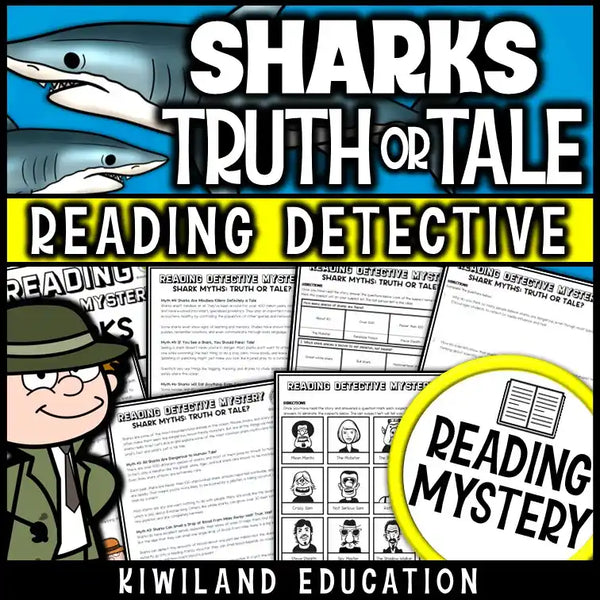
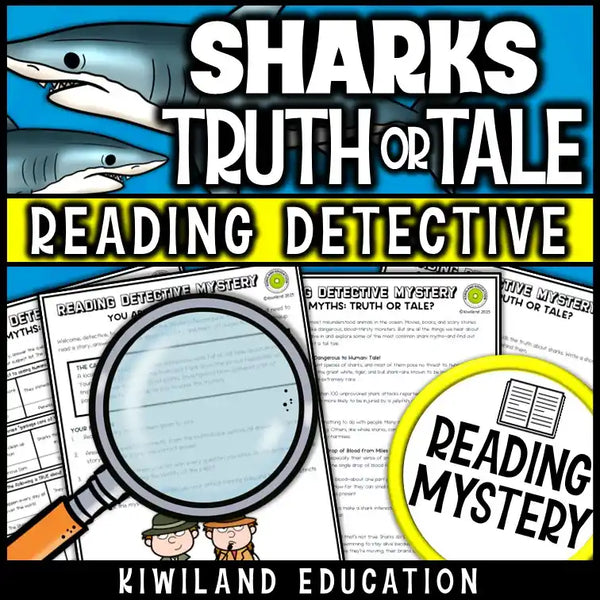
Nonfiction mysteries use an informational passage on a real science or social studies topic, so students build content knowledge while they read for facts, main idea, and text evidence. The Shark Myths: Truth or Tale? case sorts fact from fiction about sharks, and the Animal Adaptations case covers camouflage and habitats.
Both types use the same clue-and-suspect structure, so once a class has played one, they can pick up any case in seconds.
What reading skills do students practice?
A single case usually works several standards-aligned skills at once:
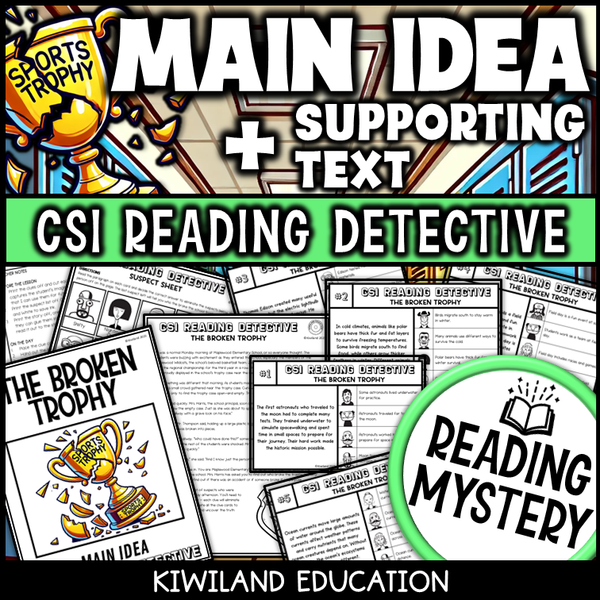
- Finding the main idea and key details, which is the focus of the Main Idea and Inferencing case
- Making inferences and drawing conclusions
- Citing text evidence to support an answer
- Vocabulary and context clues
- Sequencing, cause and effect, and comparing details across a passage
- Close reading of nonfiction, including real-world topics such as the Digital Citizenship and Internet Safety case
Why do Reading Mysteries work in the classroom?
The mystery format gives every comprehension question a purpose. Instead of answering questions because the worksheet says to, students answer them to catch a suspect, and that small shift is enough to pull in readers who usually tune out. The work underneath is still rigorous: they weigh evidence, make inferences, and defend a conclusion. Nonfiction cases add a second payoff, since students absorb real science or social studies content while they practice reading. And because each case is print-and-go with answer keys and instructions included, the prep cost for you is close to zero.
No prep, ready to print
Hand out your first Reading Mystery this week
Pick a case, print it, and let students read to catch the suspect. Answer keys and setup instructions are included, so there is nothing to prep.
Browse Reading Mysteries →Are Reading Mysteries good for test prep?
Yes. They rehearse the exact skills reading assessments measure, including main idea, inference, and text evidence, without the usual test-prep dread. The game framing keeps reluctant readers moving, and the answer keys make it easy to spot which skill needs reteaching. They also make a strong review after state testing, when students are done with worksheets but you still want them reading. The Haunted Hallway Halloween case is a popular pick for those restless in-between weeks.
How can I use Reading Mysteries in the classroom?
A few teacher-tested options:
- Literacy centers and stations
- Partner or small-group reading
- Independent close-reading challenges
- End-of-week comprehension review
- Sub plans and low-prep days
- Test-prep practice that does not feel like drilling
What grade levels are Reading Mysteries for?
Most Kiwiland cases target Grades 3 to 6, with a growing set of Grades 5 to 8 science mysteries for middle school. Passages and questions can be scaffolded down for intervention or extended for enrichment, so a single case can work across a mixed-ability class.
Are Reading Mysteries aligned to standards?
Yes. Each case targets grade-level reading comprehension standards, including main idea, inference, text evidence, and vocabulary, and gives students repeated, spiral practice with them. They map cleanly to Common Core (Reading: Informational and Literature), TEKS, the Australian Curriculum, and other standards-based literacy frameworks.
What makes Kiwiland Reading Mysteries different?
Unlike generic comprehension worksheets, Kiwiland Reading Mysteries use original, high-interest passages, blend literacy with real content knowledge, and are scaffolded so students can work on their own. Every case ships with answer keys and setup instructions, and there are seasonal options across the year, from the Thanksgiving Missing Turkey case to the Christmas Missing Sleigh.
Where to start
Browse the full Reading Mysteries collection to find cases by topic, grade, and season, then print one and hand it out. Most classes need no introduction beyond "read the passage and catch the suspect."
Read next
- What Is a Math Mystery? A Standards-Based Way to Reinforce Math Skills
- Transform Shark Week: Engaging ELA and Science Activities
- The Perfect Post-Testing Activity: End-of-Year ELA Scoot Mystery
More Reading Mysteries to try