Area and Perimeter
Mystery Detective Worksheets · Grade 3 · Counting Unit Squares
Instant PDF download after checkout. Prefer TPT? It's there too.
Inside the case file
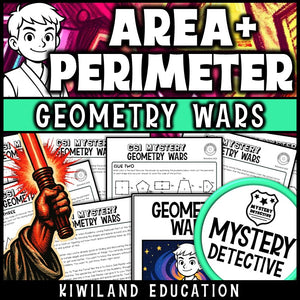
Area and perimeter worksheets, counting unit squares practice, and geometry review activities for 3rd grade math are all included in this no-prep Mini Mystery Detective pack. Every figure is drawn on squared paper, so students find the AREA by counting the squares inside a shape and the PERIMETER by counting the units all the way around its edge. Perfect for math centers, morning work, homework, review and independent practice, and completely no prep - just print and go.
There are no formulas to memorize, no rulers, and no units to convert. This is the stage of area and perimeter that comes before the formula: a student who can count squares and walk an edge is ready for length times width, and one who cannot will guess at it for years. Every case is self-checking, so a miscount shows up on the page straight away instead of in a teacher's marking pile.
What's Inside
Ten one-page cases, each a different place to measure. Four pages ask only for area, four ask only for perimeter, and the last two mix the two questions on one page so students have to read which is being asked:
- Finding area by counting the unit squares inside a figure
- Finding perimeter by counting the units around the outside edge
- Rectangles, and rectilinear shapes such as L, T, U and staircase figures, so students cannot shortcut with a formula
- Telling area and perimeter apart when both questions appear on the same page
- Recognizing that two shapes can share an area and have different perimeters
- Reading a labeled figure and choosing the right count for the question asked
- Complete red-ink answer keys for every case
The ten cases: The Sandpit Squares, The Fence Post Count, The Tiled Hallway, The Mirror Frame Case, The Patio Slab Mix-Up, The Running Track Lap, The Window Pane Plot, The Roof Edge Puzzle, The Blueprint Blunder and The Lawn Stripe Swap.
What is a Mini Mystery Detective?
A Mystery Detective is a print-and-solve detective activity that feels like a classroom escape room without the locks, the tech or the prep. Each page is one case with a line-up of suspects, and every suspect wears an ID number. Students work out each figure, match the answer to a suspect's ID, and cross that suspect off. One suspect is left standing, and that is the villain.
That is also what makes the page self-checking. Every correct answer removes exactly one suspect, so a student who miscounts a shape finds two suspects standing at the end and knows to go back and check their work before anyone tells them to.
When to Use This Resource
- Math centers and small group rotations
- Morning work and bell ringers
- Independent practice while you run a guided group
- Homework that a family can help with without a lesson
- Geometry and measurement review before state testing
- Early finishers and enrichment
- The days after a unit, when the skill needs keeping warm
Grade Levels
Designed for 3rd grade area and perimeter, where counting unit squares is introduced. Also beneficial for 4th graders who need the concrete stage back before formulas, and for advanced 2nd graders who are ready for a challenge.
Why Teachers Love Mystery Detectives
- Completely no prep - print one page per student and hand it out
- Self-checking, so students find their own mistakes
- The detective hook keeps students working through sixteen figures without complaint
- Every page is one case, so they can be used in any order
- Builds careful counting and precision, not formula recall
- Answer keys included for every case
Love this resource?
Follow Kiwiland Education to discover more Mystery Detectives, geometry and measurement activities, and detective-themed worksheets for elementary classrooms.