
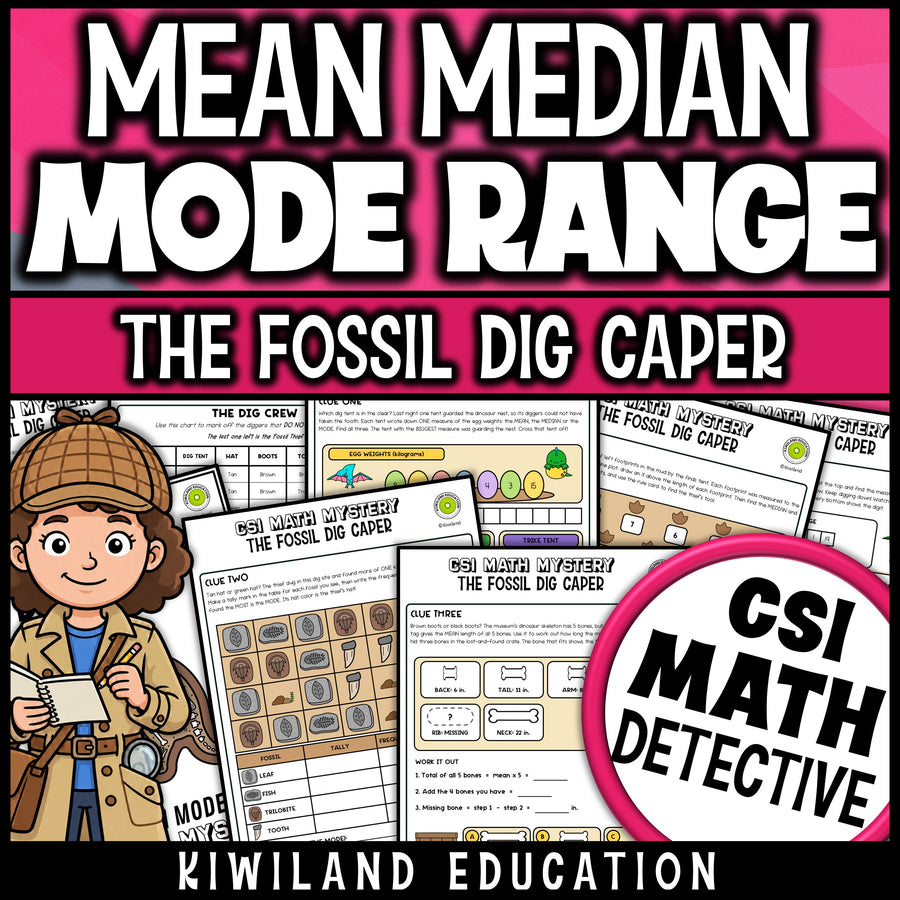
Mean Median Mode Range CSI Mystery Worksheets
Grades 3–6 · Fossil Dig Caper
Sold on Teachers Pay Teachers, where your purchases and downloads are kept.
Inside the case file
This mean median mode range activity with line plot worksheets and tally charts gives your 3rd, 4th or 5th grade class one complete CSI Mystery Detective case about a missing T. rex tooth. Students find the mean, median, mode and range of real-looking data, and they read a frequency table and a line plot along the way. The dinosaur dig theme suits any month. It's a good fit for a statistics review, a small group, or a whole-class challenge on a data day. There's no prep, and the answer key is included.
A giant T. rex tooth has vanished from the finds tent at a summer fossil dig, and one of fifteen diggers took it. Your students sort dinosaur egg weights, tally fossils in a dig site and work out the length of a missing bone. Then they plot a trail of footprints and dig down through rock layers to the thief's number. Each clue removes a few diggers from the chart. A wrong median or a miscounted tally points to the wrong diggers, and students can catch it before the last clue.
What Is a CSI Mystery Detective?
Students solve one case over five clue pages. They read the story first, then work each clue's data puzzle. Every answer tells them one thing about the thief, such as which tent they sleep in or the color of their boots, and they cross off anyone on the suspect chart who doesn't match. After clue five there's one digger left.
What's Inside
- One dinosaur dig case, The Fossil Dig Caper, with a story page, a suspect chart of 15 diggers and five clue pages
- Sorting a data set and finding its mean, median and mode
- A tally chart and frequency table built from a dig site full of fossil pictures
- Finding a missing value when the mean is given, in three short steps
- A line plot of footprint lengths measured to the nearest half inch, with the median and range
- A rock layer puzzle that mixes all four measures. Wrong answers lead to the wrong fossils.
- Color and black and white copies of every page
- The answer key, plus a key suspect chart that shows which clue removes each digger
- Teacher instructions. 30 pages in all.
The Clues
- Clue One - the dinosaur nest: find the mean, median and mode of the egg weights, and the biggest one clears a dig tent
- Clue Two - the dig site tally: the fossil found most often (the mode) gives the hat color
- Clue Three - the missing bone: use the mean on the museum tag to find the bone's length, which gives the boot color
- Clue Four - the footprint line plot: plot lengths to the half inch, then compare the median and the range to find the thief's tool
- Clue Five - the rock layers: each answer names the next fossil to dig into, down to the last digit of the digger number
When to Use This Resource
Use it once your class has learned mean, median, mode and range, or as a review before a data test. It suits sub plans, math centers and early finishers who want a longer task. Pairs can split the clue pages and meet back at the suspect chart. Homeschool families can use it as a data project, since the story takes place at a dig site and a museum.
Grade Levels
Written for 3rd, 4th and 5th grade data units. Most numbers are friendly whole numbers, so younger students can focus on the measures. The footprint line plot uses half inches, the way 4th and 5th grade line plots do. It matches Virginia's 5th grade work on line plots and the mean, median, mode and range, and it works as a 6th grade warm-up before mean absolute deviation and box plots.
Why Teachers Love Mystery Detectives
The data looks different on every page: eggs in a nest, fossils in a grid, bones on a board and footprints in the mud. Kids keep working because each answer moves the case forward. When a group gives you a name, you can check it against the key in a few seconds.
Want more cases like these?
Follow Kiwiland Education to discover more CSI Mystery Detective cases, no-prep math activities, and detective-themed printables for elementary classrooms.
https://www.teacherspayteachers.com/Sellers-Im-Following/Add/Kiwiland
You might also like
 Christmas Multiplication & Long Division CSI MysterySee the case file →
 Mean Absolute Deviation & Box Plots CSI Mystery WorksheetsSee the case file →
 Thanksgiving Multiplication and Division CSI Mystery WorksheetsSee the case file →
 Thanksgiving Decimals CSI Mystery WorksheetsSee the case file →
 Thanksgiving Fractions CSI Mystery WorksheetsSee the case file →
 Ratios and Rates CSI Mystery WorksheetsSee the case file →