
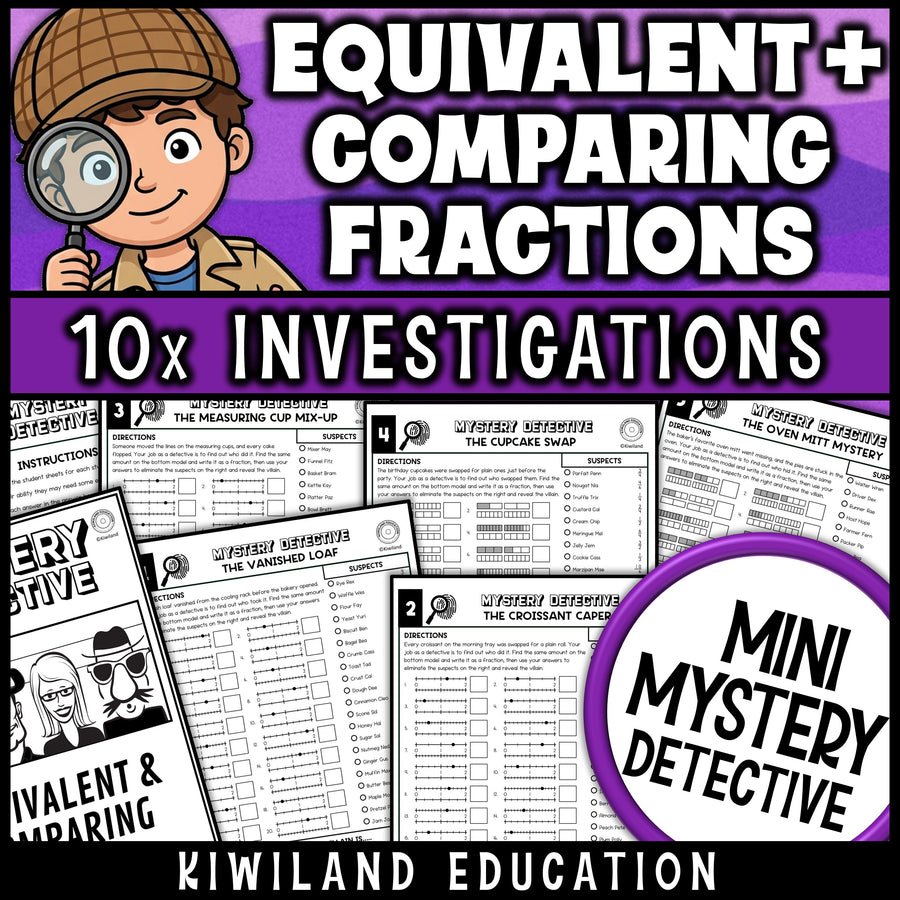
Equivalent & Comparing Fractions
Mystery Detective · Grades 3–4 · Bakery
Sold on Teachers Pay Teachers, where your purchases and downloads are kept.
Inside the case file
Equivalent fractions and comparing fractions worksheets for 3rd grade, set out as ten no prep CSI Mini Mystery Detective math cases with a bakery theme. The pages cover equivalent fractions on a number line and with fraction bars, and comparing fractions with the same numerator or the same denominator, all from 3.NF.A.3. They work well as math center tasks or morning work during your fractions unit, and you can send them home for homework too. Every case has its own answer key.
Things keep going wrong at the neighborhood bakery. A loaf disappears from the cooling rack, somebody swaps the birthday cupcakes, and the flour scale gets tipped. Your 3rd graders are the detectives on the case. Each equivalent fraction they name and each pair of fractions they compare clears one more suspect. The pages are self-checking, because every answer has to match a suspect's badge. When one name is left, they've found the culprit.
What Is a CSI Mini Mystery Detective?
It's a one-page case. Twenty problems fill the left side, and down the right side there's a column of twenty-one suspects with a fraction on each badge. Students solve a problem, look for the badge with that fraction and cross the suspect off. After the last problem there's one suspect nobody has crossed out, and that name is written in the villain box.
What's Inside
- 10 one-page bakery cases with 20 problems each, 200 problems in all
- An answer key for every case. The keys show the working on the number lines, the bars and the comparison circles
- Cases 1 to 3 use two number lines from 0 to 2, one above the other. Students name the marked point in the bottom line's parts
- Cases 4 to 6 use fraction bars with two wholes each
- Cases 7 to 10 compare two fractions with the same numerator or the same denominator. Students write < or >, then the greater fraction
- Halves, thirds, fourths, sixths and eighths, with some fractions greater than 1
- Two reference pages: Equivalent Fractions and Comparing Fractions
- A Standards Covered page with the CCSS, TEKS and Virginia SOL codes
- Teacher instructions, a contents page, a detective's case log and a Fraction Detective certificate
- 32 pages for black and white printing
The Cases
- The Vanished Loaf - equivalent fractions on number lines from 0 to 2
- The Croissant Caper - more number line pairs
- The Measuring Cup Mix-Up - number lines, the last of the three
- The Cupcake Swap - equivalent fractions with fraction bars
- The Oven Mitt Mystery - shaded bars in two wholes
- The Missing Whisk - fraction bars, some shaded past one whole
- The Tipped Scale - comparing fractions with the same denominator
- The Spoon Shortage - comparing fractions with the same numerator
- The Cold Oven - ten of each kind of comparison
- The Spilled Coffee - mixed comparing review
When to Use This Resource
Start with the first three cases when your class first sees equivalent fractions as the same point on a number line. The fraction bar cases come next, and Cases 7 to 10 go with your lessons on comparing fractions. You could also work through a case with a small group or put two problems on the board as a bell ringer. A case or two can go in your sub plans, and the pack makes a good review in the weeks before spring testing. 4th grade teachers can use it as a warm-up before equivalent fractions with bigger denominators. It suits homeschool families as well.
Grade Levels
Written for 3rd grade (3.NF.A.3a, 3.NF.A.3b and 3.NF.A.3d). In 4th grade it's a quick review before 4.NF.A.1 and 4.NF.A.2.
Why Teachers Love Mystery Detectives
The layout doesn't change from one Mystery Detective pack to the next. Students learn it on their first case, and after that they can get started without help. Any case can be used on its own, so you're free to pick the one that matches today's lesson. Naming the villain gives each page a clear finish, and the answer keys make checking quick.
Want more cases like these?
Follow Kiwiland Education to discover more CSI Mini Mystery Detective cases, no-prep math activities, and detective-themed printables for elementary classrooms.
https://www.teacherspayteachers.com/Sellers-Im-Following/Add/Kiwiland
You might also like
 Fractions CSI Mystery WorksheetsSee the case file →
 Fractions CSI Mystery WorksheetsSee the case file →
 Understanding FractionsSee the case file →
 Fractions on a Number Line Digital Escape RoomSee the case file →
 Simplifying Fractions Digital Escape RoomSee the case file →
 Fractions CSI Mystery WorksheetsSee the case file →