
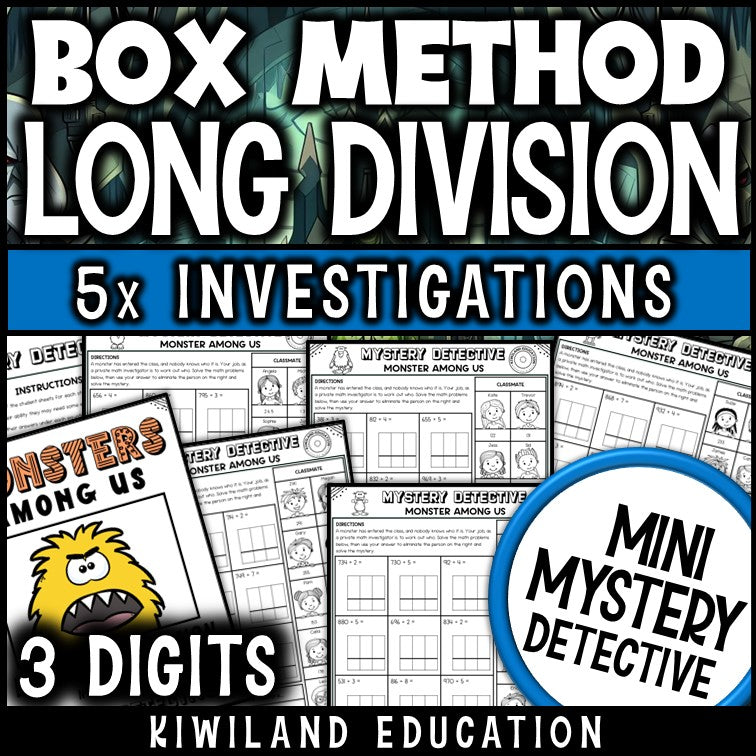
3-Digit Box Method Long Division (No Remainders)
Mystery Detective Worksheets · Grades 3–7 · Monster Theme
Instant PDF download after checkout. Prefer TPT? It's there too.
Inside the case file
Grade 4 and grade 5 box method division, 3 digit dividends by a single digit with no remainders: one CSI Mini Mystery Detective math case across five crime sheets, where each quotient crosses a suspect off the lineup until the Monster Among Us is found. Division worksheets that check themselves, because a quotient that matches no suspect sends the student back into the box. Print and go with full answer keys, for the division unit, math centers, early finishers, homework, morning work and sub plans.
Three digit dividends are where the box method earns its place, and a class will work through five CSI Mini Mystery Detective math sheets to find the monster when they would stall on a plain page. Use one sheet a day in the week you teach the method, and keep the set for spiral review before long division proper.
Monster Among Us
A monster has joined the class, and the only way to work out which one it is, is to divide. Every quotient a student lands on takes one suspect off the lineup, and all five crime sheets run this same case, so the hunt carries on from one page to the next until a single name is left.
What's Inside
- Five crime sheets, each with its own lineup of suspects, all running the one case
- Box method division with a 3 digit dividend and a single digit divisor
- No remainders, so every quotient matches a suspect exactly
- Each answer matches one suspect and no other, so the page checks itself
- A full answer key for every sheet
- Print and go: no cutting, no laminating, nothing to prepare
What Is a CSI Mini Mystery Detective?
A CSI Mini Mystery Detective is a printed case with a lineup of suspects, each carrying a number. The questions on the crime sheet produce those numbers, a correct answer strikes one suspect off, and the last name standing is the culprit. The elimination only works when the math is right, which is what makes these detective activities catch errors that a page of math worksheets would let through. One case fits one class period, with nothing to prepare.
When to Use This Resource
Use this the day after you introduce the box method, while students still need the steps in front of them but not another worked example. Three digit dividends and no remainders keep the load light enough that the method is what they are thinking about. Because the wrong quotient takes out the wrong suspect, a student who drops a step finds out immediately instead of repeating it five times.
It carries test prep, homework, math centers, morning work, early finishers, sub plans and homeschool lessons, with a class, a small group or a single student.
Grade Levels
Written for 4th grade and 5th grade, where dividing by a single digit sits in the standards. Third graders take it once they know their division facts, and 6th graders use it as a quick refresher before moving to two digit divisors.
Why Teachers Love These Cases
- Three digit dividends, which is the right size for a first week with the method
- Students see a dropped step straight away when the wrong name comes off
- No prep, and the answer key makes grading quick
- Works with a whole class, a small group, partners, or one student alone
Love this resource?
Follow Kiwiland Education to discover more CSI Mini Mystery Detective cases, no-prep math activities, and detective-themed printables for elementary classrooms.
You might also like
 Multi-Digit Multiplication Digital Escape RoomSee the case file →
 4-Digit Addition & SubtractionSee the case file →
 2-Digit by 2-Digit Area Model MultiplicationSee the case file →
 Long Division CSI Mystery WorksheetsSee the case file →
 Place Value: Word Form to Standard FormSee the case file →
 3-Digit by 1-Digit Area Model MultiplicationSee the case file →