This is a free order of operations game for 5th and 6th grade: a five-minute detective case you put on the board and solve as a class. It practices 5.OA.A.1 (evaluate expressions with parentheses) and 6.EE.A.1 (expressions with exponents). There are no logins, no student accounts and nothing to print unless you want the full case afterwards.
Why it works for order of operations
Every clue is an expression the class has to evaluate before it can clear anyone: is the badge greater than 3 + 4 × 2? Less than (10 − 4) × 3? More than 2² + 3 × 4? If someone adds before multiplying they clear the wrong suspects and the case will not close, which is the whole lesson in one wobble.
How to run it
- Put it on the board. Tap Put it on the board above the case and it fills the screen. Six suspects, each wearing a badge number. One of them did it.
- Read clue 1 out loud. The class works out which badges the clue rules out. Tap each suspect it clears; a correct tap stamps them CLEARED, a wrong one just wobbles.
- Clues 2 and 3 unlock as you go. Keep clearing until one suspect is left, then tap them to close the case. The reveal explains every clue.
- Play it again. New lineup keeps the clues and shuffles the suspects. New clues gives you a fresh case. Round 2 and Round 3 are waiting in the tabs.
Three tips from the classroom
- Write the expression on the board and work it in order with the class before anyone taps.
- Ask what do we do first? every clue. Parentheses, exponents, multiply or divide, add or subtract.
- When a badge wobbles, go back to the expression. Nine times out of ten the class added first.
Making it easier or harder
For 5th grade, tap New clues until the set has no exponents, or just read the exponent as 3 × 3. For 6th grade, give students a minute to evaluate all three clues silently before the first tap.
Questions teachers ask
Does it include exponents?
Yes, small squares like 2² and 3². Parentheses, multiplication, addition and subtraction all appear.
What numbers does it use?
Badges from 6 to 60. The expressions evaluate to numbers in the same range, so comparing is quick once the expression is right.
Is there a printable version?
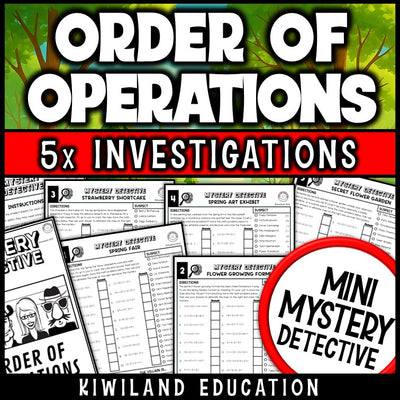
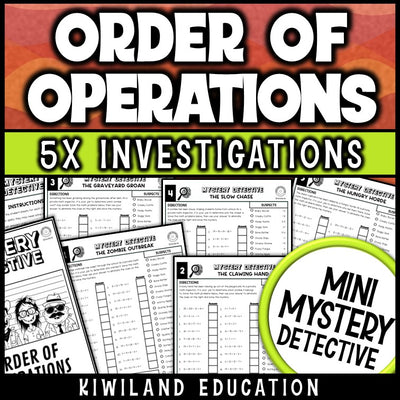
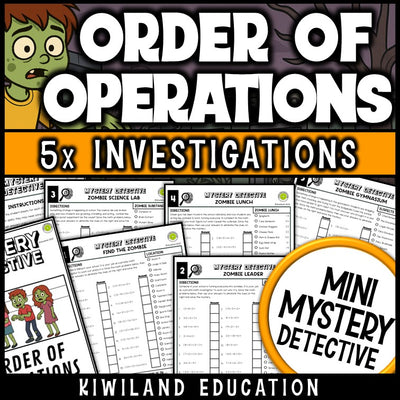
The packs below are the printable version on the same standard: a page of order of operations problems, a lineup of suspects, every right answer crosses one off. Answer keys included.