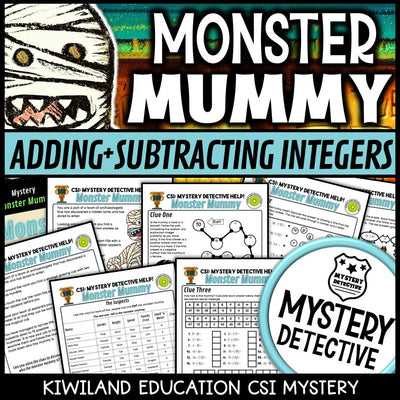
This is a free integers game for 6th and 7th grade: a five-minute detective case you put on the board and solve as a class. It practices 6.NS.C.5–7 (positive and negative numbers, opposites, absolute value, ordering) and 7.NS.A.1 (add and subtract integers). There are no logins, no student accounts and nothing to print unless you want the full case afterwards.
Why it works for integers
The badges run from −15 to 15 and the clues are the ideas students mix up: is the badge greater than −3 − 5? More than 4 away from zero? Is its opposite 7 or more? The class has to place every badge on the number line to clear it, and the student who thinks −9 is bigger than −2 is found out by the game, not by you.
How to run it
- Put it on the board. Tap Put it on the board above the case and it fills the screen. Six suspects, each wearing a badge number. One of them did it.
- Read clue 1 out loud. The class works out which badges the clue rules out. Tap each suspect it clears; a correct tap stamps them CLEARED, a wrong one just wobbles.
- Clues 2 and 3 unlock as you go. Keep clearing until one suspect is left, then tap them to close the case. The reveal explains every clue.
- Play it again. New lineup keeps the clues and shuffles the suspects. New clues gives you a fresh case. Round 2 and Round 3 are waiting in the tabs.
Three tips from the classroom
- Draw a number line from −15 to 15 on the board and mark the six badges before the first clue.
- For away from zero clues, say the words absolute value and write the bars.
- When a clue is a subtraction like −3 − 5, model it as a jump on the line before the class decides.
Making it easier or harder
For 6th grade, stay on ordering and opposites by tapping New clues until the set suits you. For 7th grade, add the rule that students must write the result of each clue's calculation before anyone taps.
Questions teachers ask
What numbers does it use?
Integers from −15 to 15, never zero. Clues cover positive and negative, opposites, distance from zero, odd and even, and adding, subtracting and multiplying across zero.
Is it too easy for 7th grade?
Run it as a two-minute warm-up before an integers lesson. The speed is the point, and the third round is usually the one that catches someone.
Is there a printable version?
The packs below are the printable version on the same standards: a page of integer problems, a lineup of suspects, every right answer crosses one off. Answer keys included.