
Simplifying Radicals
Mystery Detective · Grades 8–10 · Museum Heist
Sold on Teachers Pay Teachers, where your purchases and downloads are kept.
Inside the case file
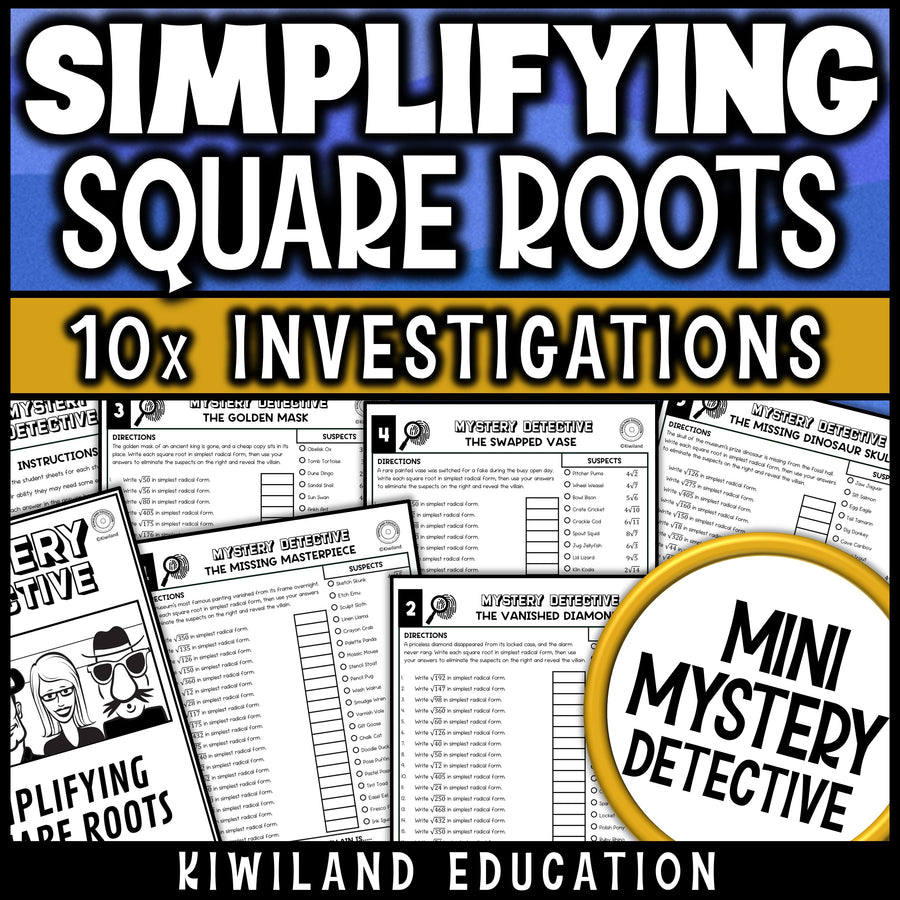
Simplifying radicals practice for 8th grade and Algebra 1, set out as ten CSI Mini Mystery Detective math cases with a museum heist theme. On every page, students write square roots of whole numbers in simplest radical form. Use the cases in math centers, as homework or as an early finisher activity. It's no prep, and there's an answer key for each case.
A painting, a diamond and even a mummy have gone missing from the museum, and your students are the detectives on the case. Every square root they simplify rules out one suspect. Once the last radical on the page is done, there's only one name left on the list. If their work is right, that name belongs to the thief.
What Is a CSI Mini Mystery Detective?
It's a complete detective case on one printed page. A few lines of story open the case, and twenty problems run down the left side with an answer box beside each one. The suspects line up on the right, each wearing a badge with an answer on it. The villain's name goes in the box at the bottom of the sheet.
What's Inside
- 10 one-page cases with 20 square roots to simplify on each, 200 problems in all
- An answer key for every case
- Every root is printed with a proper radical sign, the way a textbook shows it
- Each page mixes easier and harder roots. The number in front of an answer goes from 2 up to 12
- A reference page with a perfect squares table, the four steps for √72, and two more worked examples
- Teacher instructions, a contents page, a student case log and a Museum Detective certificate
- 30 pages, black and white
The Cases
- The Missing Masterpiece - a famous painting gone from its frame
- The Vanished Diamond - a diamond missing from a locked case
- The Golden Mask - an ancient gold mask swapped for a copy
- The Swapped Vase - a painted vase switched for a fake
- The Missing Dinosaur Skull - a skull taken from the fossil hall
- The Headless Knight - a suit of armor left without its helmet
- The Stolen Sword - a jeweled sword missing from the arms gallery
- The Camera That Turned - a security camera turned to face the wall
- The After-Hours Visitor - footprints past the velvet ropes after closing
- The Wandering Mummy - a mummy gone from the ancient world hall
When to Use This Resource
Start the first case once your class has learned to take the largest perfect square out of a root. Every page has six easier problems, eight in the middle and six harder ones, and the numbers under the roots go up to 500, which makes the later cases useful before a quiz or a unit test. One case can go to a small group or a tutoring session, or be split over a few days as a bell ringer. They also suit sub plans and homeschool. Geometry and Algebra 2 teachers can use a case as a quick review before work with the Pythagorean theorem or quadratic equations, where answers come out as radicals.
Grade Levels
Made for Algebra 1 (HSN-RN.A.2) and for 8th graders who know their perfect squares (8.EE.A.2). It's also a short review for Geometry and Algebra 2 classes.
Why Teachers Love Mystery Detectives
Every Mystery Detective case is laid out the same way, and after the first one your students know the routine. Any case can be used on its own, so you can pick the one that fits the day. When an answer doesn't match any badge, students know to look at that problem again. The answer key makes checking a page quick.
Want more cases like these?
Follow Kiwiland Education to discover more CSI Mini Mystery Detective cases, no-prep math activities, and detective-themed printables for middle school and high school classrooms.
https://www.teacherspayteachers.com/Sellers-Im-Following/Add/Kiwiland
You might also like
 Solving Multi-Step Equations: Variables on Both SidesSee the case file →
 Multi-Step Equations Both SidesSee the case file →
 Systems of Linear EquationsSee the case file →
 Multi-Step Equations with Variables on Both Sides Digital Escape RoomSee the case file →
 Multi-Step Equations With BracketsSee the case file →
 Scientific NotationSee the case file →