Key takeaways
- December is not a short month for teaching. It is a long one that keeps getting interrupted: concert rehearsals, assemblies, a class party, a sub while you're at a holiday lunch. Plan for the interruptions, not around them.
- A shape that works for the three weeks between Thanksgiving and break: keep teaching in week one, switch to one self-checking review case a day in week two, and save the reading and the party-day activity for the last few days.
- Every right answer eliminates one suspect, so a wrong answer shows up on the page without you. That is what lets a case survive a fire drill halfway through.
- Real standards underneath, Grades K to 8: 2.NBT.B.5, 3.NBT.A.1, 4.NBT.B.5, 5.OA.A.1, RL.3.1, RI.4.9 and more, listed with each pack below.
The best Christmas math and reading activities for December are the ones that still count as a lesson when the schedule falls apart around them. And it will fall apart. December has more school days than Thanksgiving week, but far fewer whole ones. Tuesday's math block loses twenty minutes to choir. Thursday afternoon is the assembly. One Friday is the party, and nobody tells you which period until that morning.
So the December problem is not excitement (that was October) and it is not a missing week (that was November). It is fragmentation. The fix is work that is small enough to finish in whatever piece of a period you get, and that checks itself so nobody has to grade forty half-finished pages over break.
What should you teach in the last three weeks before Christmas break?
Teach for one more week, then review. Most classes still have real instruction left in them in the first week of December, and giving it up because the hallway has a tree in it costs you a week you will want back in March. After that, the honest picture is this:
- The period you planned is rarely the period you get. Rehearsals and assemblies take a bite out of the day without warning. A task that needs a full 50 minutes and a whole-class debrief is the first casualty.
- The unit you closed in November is already fading. Regrouping, multiplication facts, rounding. Two weeks off at Christmas will finish the job unless it gets practiced now.
- You will not grade over break. Be honest about it. Whatever you hand out in the last week needs to tell the student whether they're right before it ever reaches you.
That last point is the reason the mystery format earns its place in December. Students solve each problem, then match the answer to a suspect's number. Each correct answer eliminates exactly one suspect. A wrong answer matches nobody, or crosses off the wrong person, and the case won't close. Students go back and fix it themselves, and a case stopped by a fire drill picks up exactly where it left off.
A three-week plan for December
| When | What to run | Why then |
|---|---|---|
| Week 1 | Keep teaching your current unit. On Monday, hand every student a Christmas case packet to keep in their desk for when they finish early. | Attention is still normal, and the packet gives early finishers something real to do all month |
| Week 2 | One one-page case a day as the math warm-up, on the unit you closed in November. Run a longer CSI case across the week for the group that needs more. | This is the week rehearsals start eating periods. A one-page case fits whatever is left of one. |
| Last 2–3 days | Christmas Around the World as the reading lesson. On party day, a digital escape room or a fiction Reading Mystery. | The reading is the lesson students can't get anywhere else this month. Party day needs something a class can run without you. |
The week-one packet idea comes from a teacher, not from me. One 3rd grade teacher wrote that she hands these out at the beginning of the month and students work on them when time allows. It solves the early-finisher problem for all of December with one trip to the copier.
If your district breaks later or earlier, stretch or squeeze week two. It is the flexible part. Keep the reading, whatever happens to the rest.
Christmas math cases, and the standard under each one
Who Stole the Sleigh? (two- and three-digit addition and subtraction with a little multiplication, Grades 2–5, 2.NBT.B.5, 3.NBT.A.2, 3.OA.C.7). Somebody at the North Pole has sabotaged the sleigh days before Christmas, and the helpers are already on double shifts. The clue pages vary: a trail of presents where the running total decides the clue, a map read with a key, a decoration colored by the right product. Color and black-and-white versions, answer keys included. 4.76★ from 25 ratings on TPT.
Secret Santa (two- and three-digit addition and subtraction, Grades 2–5, 2.NBT.B.5, 2.NBT.B.7, 3.NBT.A.2). One gift out of the hat was not what it should have been, and nobody will own up. If your class is running its own gift swap, this is the one to pick. Students decode a map, follow an addition path where an odd or even total settles the clue, and finish on subtraction. 4.8★ from 30 ratings.
2-Digit by 1-Digit Multiplication (Grades 3–5, 4.NBT.B.5). Five one-page cases: the missing decorations, the cookie somebody got to first, the candy cane left for the teacher. One case fits one period, which makes this the backbone of week two. 4.92★ from 12 ratings. Its partner, 2-Digit by 2-Digit Multiplication (Grades 4–6, 4.NBT.B.5), leaves room on the page for the partial products.
One intervention teacher runs these as a jigsaw, and it is worth stealing for a small group. She gives each student one line of questions, then pairs check each other's answers with calculators before the group puts the page together and names the culprit. Five students, one page, and everyone's work matters to the ending.
Order of Operations (no exponents, Grades 4–7, 5.OA.A.1). An unsigned gift, a box of chocolates left at the tree, carols from somewhere down the hall. December is when students quietly go back to working left to right, and a wrong order crosses off the wrong suspect, so the page catches the habit for you. 5.0★ from 16 ratings, every one of them five stars.
For the younger and the in-between grades. 2-Digit Addition with Regrouping (Grades 1–3, 2.NBT.B.5), 3-Digit Subtraction with Regrouping (Grades 2–4, 2.NBT.B.7, 3.NBT.A.2) and Rounding to the Nearest 10 and 100 (Grades 2–4, 3.NBT.A.1), which splits into three cases on each place, so the nearest 10 can go one week and the nearest 100 the next.
A Christmas reading lesson that is really a geography lesson
Most December reading is about Santa. That's fine for a fun day, but you can get a real comprehension lesson out of the holiday by looking past your own town. Christmas in Sydney or Rio de Janeiro happens in summer. Families in Mexico, Sweden and the Philippines each keep traditions of their own. Students tend to assume the way their family does December is the way everyone does it, and finding out otherwise is genuinely interesting to them.
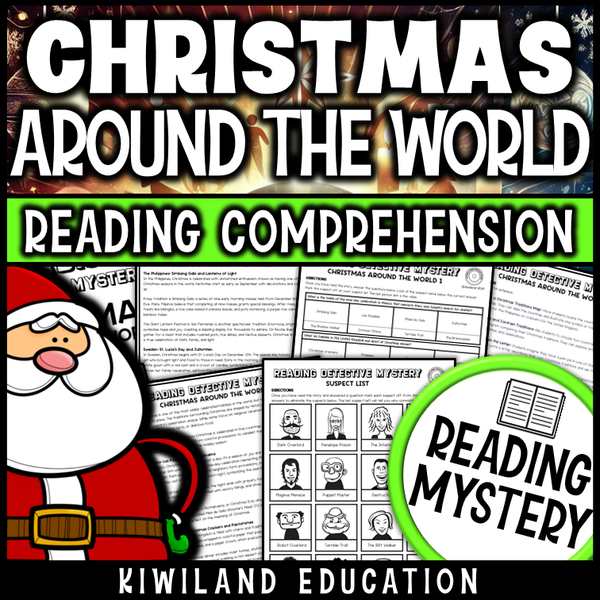
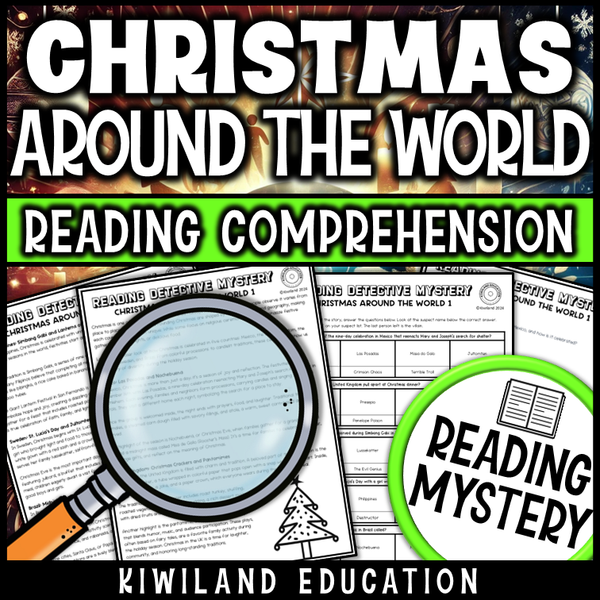
There are two nonfiction Christmas Around the World Reading Mysteries, and they work best as a pair:
- Christmas Around the World: Holiday Celebrations compares Mexico, the United Kingdom, the Philippines, Sweden and Brazil.
- Christmas Around the World: Global Traditions covers Germany, Australia, Italy, Japan and the United States.
Each is a two-page passage with 15 comprehension questions, written-response questions, a word search and extension tasks, for Grades 3–6 (RI.4.1, RI.4.2, RI.4.3). Each answer rules out a suspect, so students go back into the text for the evidence instead of guessing. Run one on day one and the other on day two, and the second day becomes a lesson in integrating information from two texts on the same topic (RI.4.9, RI.5.9): ten countries, two passages, one chart students fill in comparing them. It also doubles as social studies if your ELA block got cut short by the concert.
For the party day, or any day you need the room to settle, the fiction is better. The Case of the Missing Sleigh starts with the sleigh vanishing from the North Pole flight hangar, and Santa's Lost List sends students after the missing Nice and Naughty List (both fiction, Grades 3–6, RL.3.1, RL.3.2, RL.3.3). They are built for inference, sequence and character questions, with sample answers for the written responses.
What teachers say after running them
Verified purchasers on TPT, quoted as written:
"A great activity to keep the kids happy and busy! We were doing Secret Santa in class as well, so this fit in well."
— Andrea H., 3rd and 4th grade, on Secret Santa (4.8★, 30 ratings)
"This was a fun way to incorporate math in that last week before break!"
— Robin W., 3rd grade, on Secret Santa
"I love this activity and so did my class. It was a mystery game but they learned so much while doing it."
— Gia S., 5th grade, on Christmas Around the World
"Lots of fun and investigating to figure out who the culprit is."
— Carolyn J., 8th and 9th grade English learners, on Santa's Lost List
That last one was a teacher using a Grades 3–6 story with older students still learning English, for their final class before break. The format carries more than the reading level does. Across the whole catalog, teachers have left 10,000+ ratings averaging 4.84★.
Christmas activities by grade
Grades K–2. Digital Escape Rooms for Counting to 20 (K.CC.A.1), CVC words and CVCe words, plus Addition and Subtraction Within 100 (2.NBT.B.5). On paper, 2-Digit Addition with Regrouping. More at Grade 2 Number and Operations in Base Ten.
Grades 2–4. Who Stole the Sleigh?, Secret Santa, Rounding to the Nearest 10 and 100, and the Measuring Christmas Trees escape room (2.MD.A.1). Browse Grade 3 Number and Operations in Base Ten.
Grades 3–6. The two multiplication packs for Grade 4 Number and Operations in Base Ten, 4-Digit Subtraction with Regrouping (4.NBT.B.4), the 10x Times Tables escape room (3.OA.C.7) and Christmas Multi-Step Word Problems (4.OA.A.3). More fact practice at Grade 3 Operations and Algebraic Thinking.
Grades 4–8. Order of Operations on paper or as an escape room (5.OA.A.1, see Grade 5 Operations and Algebraic Thinking), decimal word problems (5.NBT.B.7) and One-Step Equations (6.EE.B.7). See also Grade 6 Expressions and Equations.
For the ELA block. The four Reading Mysteries above, plus the Context Clues, Figurative Language and Multisyllabic Words Digital Escape Rooms.
Party day. All the rooms are in Christmas Digital Escape Rooms. They run in a browser with nothing to set up, so a class can work through one while you're handing out cookies.
Three weeks, one trip to the copier
December can still be a real month.
Pick a case packet for the unit you closed in November, add the Christmas Around the World pair for the last days, and keep one escape room ready for the party.
Browse Christmas Activities →FAQ
How long does a Christmas mystery take? A one-page Mystery Detective case fits one class period, or two short pieces of one. The longer CSI cases, like Who Stole the Sleigh?, have five clue pages and are built to run across a week.
Is there any prep? Print and go. No cutting, laminating, apps or student logins, and every pack includes the answer key. The Digital Escape Rooms open from a link.
What happens if we get interrupted halfway through? Nothing is lost. Each crossed-off suspect is a record of the problems already solved, so students pick up at the next clue. That is the main reason these suit December.
What if my school doesn't celebrate Christmas? The Christmas Around the World passages are taught as culture and geography, which many schools are comfortable with. For a fully neutral option, the Winter Activities collection carries the same skills with snow instead of Santa.
Can a substitute run these? Yes. A wrong answer fails on the page, so a sub doesn't need to know the content to keep students accurate, which helps on the day you're out for a holiday lunch or a family event.
Read next